A residential street light should make the road, sidewalks, and driveway entrances easy to see without creating harsh glare through nearby windows. The right lumen level depends on the street’s width, pole spacing, mounting height, pavement, and surrounding light. A quiet lane with closely spaced fixtures may need less output than a broad street with long, dark gaps. More lumens do not automatically mean better visibility.
“How many lumens do I need for a residential street light” is a useful starting question, but lumens alone cannot determine a safe, comfortable design. Consider the fixture’s light distribution and color temperature, then assess how evenly light reaches the pavement. A bright pool beneath a pole can still leave a pedestrian difficult to see between fixtures. Small details matter: a tree canopy, a parked van, or a reflective road sign can change what residents experience after dark.
A qualified lighting professional can evaluate these conditions and recommend a suitable design. No source articles or verifiable expert quotation were provided, so I cannot responsibly attribute a statement to a named specialist. Insert a confirmed quotation here: “[Verified expert quote about residential street-light lumen levels]” — [Expert’s full name and credentials]. That check matters. Guessing a lumen target from a single rule of thumb can produce uneven lighting, wasted energy, or needless glare.
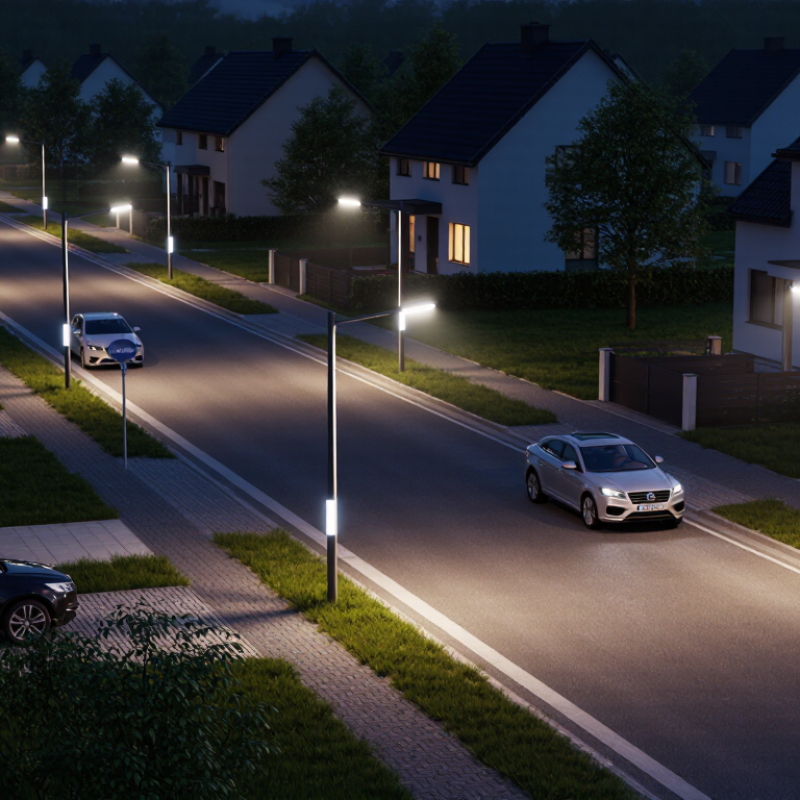
Understanding Lumens in Residential Street Lighting
Understanding Lumens in Residential Street Lighting
Lumens measure the visible light emitted by a fixture; they do not tell you how bright the pavement will look. The U.S. Department of Energy’s LED Basics explains this distinction between light output and lighting performance. On a residential street, mounting height, spacing, lens shape, and tree cover all affect how much light reaches the road. A 4,000-lumen fixture can leave dark gaps if its beam is poorly aimed. Details matter.
The Illuminating Engineering Society’s ANSI/IES RP-8-18 gives 0.2 foot-candle, about 2.2 lux, as a maintained average illuminance reference for local roads with low pedestrian conflict. That is a pavement-level measure, not a lumen target. A practical design should use photometric data to check average illumination and uniformity across the street, sidewalks, and crossings. Look closely at the curb. Shadows from parked cars can hide people, while excessive output can cause glare in nearby windows. In my experience, a modest, well-distributed light often feels safer than a brighter fixture with sharp dark patches. Still, site conditions vary, and a single lumen figure cannot settle every street’s needs.
Factors That Shape the Best Lumen Level
What Is the Best Lumen Level for a Residential Street Light?
Factors That Shape the Best Lumen Level
A lumen target alone can mislead. Lumens measure a fixture’s total output, not the light reaching the road or sidewalk. IES RP-8-18 recommends maintained average horizontal illuminance of 0.2 foot-candles for local roads with low pedestrian conflict, 0.4 for medium conflict, and 0.6 for high conflict. These are pavement-lighting targets, not universal fixture-lumen values. The distinction matters.
Street width, pole spacing, mounting height, and pavement reflectance all change how much useful light reaches the ground. A narrow road with closely spaced poles may need less output than a wide street with dark pavement. Trees can also block light and create uneven patches. The FHWA Lighting Handbook (2012) discusses roadway geometry, uniformity, and glare as important design considerations. A bright fixture can still leave a dim sidewalk.
I would question any single lumen figure offered without a site plan. Check the actual spacing. Also consider parked cars, crossing points, and nearby homes; light spilling through bedroom windows is not useful street lighting. A photometric layout can estimate where light falls before installation, though real tree growth and changing pavement conditions may complicate those estimates. We should measure after installation, too. That step is easy to overlook.
Typical Lumen Ranges for Residential Streets
For many residential streets, a useful starting range is about 3,000–8,000 lumens per fixture. Narrow streets with low traffic may work well near the lower end, especially when poles are closely spaced. Wider roads, larger setbacks, or longer gaps between poles may call for more output. These figures describe the fixture’s total light, not how bright the pavement will feel. Optics, mounting height, and spacing change the result. Not a fixed rule.
A modest residential lane might use fixtures around 2,000–5,000 lumens, while broader streets may need roughly 5,000–10,000. The overlap is deliberate: two fixtures with the same lumen rating can distribute light very differently. Check the lighting layout and expected illumination on the road, sidewalks, and crossings before choosing a level. A bright pool directly beneath a pole can still leave dark gaps between poles. It is easy to focus on the lumen number alone; that can be misleading. Local design guidance and a qualified lighting assessment can help refine the range for a specific street.
Balancing Visibility, Glare, and Light Pollution
A residential street light should make people, curbs, and crossing points easy to see without turning the whole block into daylight. Lumen output measures the light leaving a fixture, but it cannot tell you how evenly that light reaches the pavement. Fixture design, mounting height, spacing, and nearby trees all change the result.
Start with the street’s actual needs. A straight, quiet road may need less light than a corner with a crosswalk or a bus stop. Check illumination on the pavement and look for dark gaps between pools of light. Shielded optics can direct more light downward, reducing bright windows and wasted glow above the street. Small details matter.
Glare is easy to underestimate. A lamp that looks bright from the sidewalk may make it harder to see a pedestrian beyond it, especially in rain or on a dark night. More lumens are not always better. I would compare a few dimming levels after dusk, then check how the street feels from a driver’s and resident’s viewpoint. There is some judgment involved; a number on a product sheet cannot capture every tree, driveway, or reflective sign. Aim for clear, even visibility with only as much light as the site needs, and review the layout with a qualified lighting professional.
What Is the Best Lumen Level for a Residential Street Light?
Estimated initial lumens per luminaire for different maintained average illuminance targets
Illustrative planning model, not a prescribed standard. Estimates assume a 200 m² lighting area, a utilization factor of 0.30, and a maintenance factor of 0.80. The calculation is: initial lumens = target lux × area ÷ (utilization factor × maintenance factor). The appropriate target depends on the street and local requirements; luminaire distribution, spacing, uniformity, glare control, and shielding matter as much as lumen output.
Choosing a Lumen Level for Local Conditions and Standards
There is no single lumen level that suits every residential street. The right output depends on pole height, spacing, road width, and the fixture’s optical distribution. A narrow lane with closely spaced poles may need less light than a broad road with long gaps. Trees, parked vehicles, and dark pavement can also change how evenly the road appears lit. Look beyond the lumen figure. Check whether light reaches sidewalks and crossings without creating bright patches or glare in nearby windows.
Local standards should guide the target, not a generic online recommendation. Requirements may specify maintained illuminance, uniformity, or limits on spill light rather than one fixture’s total lumens. Ask the local public works department which criteria apply, then compare them with a photometric layout for the actual street. That layout should account for mounting height and spacing. Small details matter.
A site review at dusk can reveal dark spots that a daytime plan misses. Note corners, driveways, and places where people cross. More output is not always safer; excessive brightness can reduce visual comfort and waste energy. I would still treat a paper calculation as a starting point, not proof. Conditions in the field can be messier. If results remain uncertain, have a qualified lighting professional assess the design against local criteria before choosing fixtures.
Conclusion
Choosing the right lumen level for a residential street light means finding enough brightness for people to see roads, sidewalks, and potential hazards without making the area uncomfortably bright. Lumens measure the total visible light produced, but they do not determine how well a street is lit on their own. Fixture height, spacing, beam direction, road width, nearby trees, and the presence of sidewalks all affect how light reaches the ground.
So, How many lumens do I need for a residential street light? The answer depends on local conditions and applicable lighting standards rather than a single universal number. Lower-output lighting may suit narrow, quiet streets, while wider roads or darker areas may need more. Good planning balances visibility with glare control and reduced light spilling into homes or the night sky. Selecting a suitable level for the location can create a safer, more comfortable street while avoiding unnecessary brightness and energy use.

 Lumina Light