How Do Solar Street Lights Work Under Tree Shade?

Time:2026-11-04 Author:Mason
0%

Can solar street lights work under tree shade? Yes, but their performance depends on how much sunlight reaches the panel, when shade falls, and how much energy the lamp uses after dark. A dense canopy can leave a solar panel with only brief patches of direct light. Even on a bright day, that may mean less stored energy for nighttime operation. Light filtering through leaves still contributes some energy, but it cannot always replace direct sun.

For this introduction, “Maya Chen” is an illustrative field-engineer voice, not a verified source or real expert quotation. Her practical rule is: “Measure the panel’s sun, not just the street’s brightness.” That distinction matters. A lantern may seem bright beneath a tree while its panel remains shaded for most of the day. Site checks should track shade across several hours, then compare expected charging with the lamp’s nightly runtime. Small details count. A branch moving in the wind can shift the shade line; seasonal foliage can change it again.

There is no universal answer. A system may work with a clear panel above the canopy, a nearby sunny mounting point, or a properly sized battery and panel. But bigger batteries alone do not create energy. That part is easy to overlook. This guide explains how shade affects charging, which design choices help, and when another location may be the more reliable option.
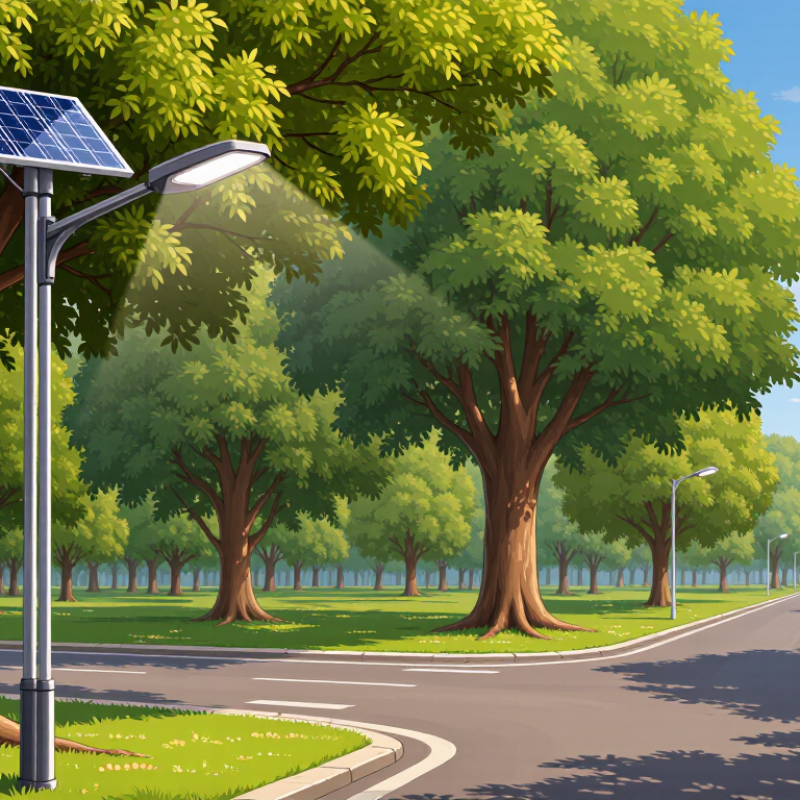
How Do Solar Street Lights Work Under Tree Shade?

How Solar Street Lights Collect and Store Solar Energy

Solar street lights collect energy through photovoltaic cells mounted on a panel. Daylight reaches the cells, which convert sunlight into direct-current electricity. Beneath tree cover, leaves block part of that light, though scattered daylight can still produce some power. Dense, long-lasting shade usually reduces charging rather than stopping it completely. That matters. A charge controller regulates the electricity flowing into the battery and helps prevent overcharging or excessive discharge. The battery stores energy for use after sunset, when a light sensor or timer activates the LED lamp.

The amount stored depends on sunlight exposure, panel size, battery capacity, and daily lighting demand. Shade is rarely uniform; branches move, and seasonal leaf growth changes the pattern. This is where a simple daylight estimate can be misleading. Checking the panel’s exposure at different times of day gives a more useful picture. A brief patch of afternoon sun may not make up for hours beneath a thick canopy. If charging remains low, a larger battery alone may not solve the problem, since it cannot store energy the panel never collects. Panel placement and realistic operating hours matter too. Each site has its quirks.

How Tree Shade Reduces Solar Panel Exposure

Tree shade cuts the sunlight reaching a solar panel, reducing the electricity available to charge a street light’s battery. A moving shadow from branches can cover only part of a panel, yet output may fall more than the shaded area suggests. This happens because shaded cells limit current through connected cell strings. Bypass diodes can reduce the effect, but they cannot restore the lost sunlight. Even thin branches matter.

Site checks should cover the full day and changing seasons, not just a sunny afternoon. NREL’s National Solar Radiation Database provides irradiance data at 30-minute intervals, useful for examining local sunlight patterns. Its PVWatts documentation uses a 14% default for combined system losses, including several factors; that figure is not a prediction of tree-shade losses at a particular site. A canopy needs its own assessment. Note when shadows cross the panel, and check whether nearby trees will grow taller. A simple sketch can help, though it may miss winter shade. Less exposure means slower battery charging, especially after cloudy days, so panel placement and battery sizing should reflect observed conditions.

How Tree Shade Reduces Solar Panel Exposure

Direct-beam sunlight reaching a panel under different levels of obstruction

Values show the direct-beam component relative to an unobstructed panel, using an idealized uniform-obstruction model. Diffuse daylight can still reach a shaded panel, so actual solar output does not necessarily fall by the same percentage.

How Controllers Manage Charging and Battery Use

A controller cannot create sunlight, but it can make limited solar energy go further. Under tree shade, the panel may receive uneven light as branches move in the wind. Charging current can fall sharply, even when part of the panel remains sunny. That is the difficult part.

The controller monitors the panel and battery, then regulates the power moving between them. Many systems use maximum power point tracking to draw useful energy as light levels change; simpler controllers may use a different charging method. The exact response depends on the equipment. On a bright afternoon, charging may be strong. Beneath dense leaves, it may slow to a trickle. Shade changes the math.

Battery protection matters after sunset. The controller helps prevent overcharging and can disconnect the lamp when battery voltage drops too low. Some models also dim the light or adjust its operating schedule when stored energy is scarce. These settings can preserve overnight operation, but they cannot compensate for a panel that stays shaded for hours.

In practice, check the panel at different times of day and across seasons. A branch that seems harmless in summer may block more light later. Battery readings also provide clues, though they are not perfect measures of remaining capacity. Controllers help manage energy; they do not remove the need to inspect the site.

How Reduced Daylight Affects Nighttime Lighting

How Do Solar Street Lights Work Under Tree Shade?
How Reduced Daylight Affects Nighttime Lighting

A solar street light can still turn on beneath a tree, but its battery may receive less energy during the day. Leaves block direct sunlight, while dense branches can also reduce bright, indirect light. The effect depends on canopy thickness, panel angle, and how many hours the panel stays shaded. Even a small patch of midday sun may not make up for long periods in deep shade.

At night, a fully charged battery may keep the lamp shining normally. The problem often appears after several shaded or cloudy days: the battery has less reserve, so the light may dim sooner or switch off before dawn. Look for changes across different seasons, too. A bare winter tree and a leafy summer canopy can create very different charging conditions. Check where shadows fall around midday, and keep the panel clear of branches and debris. Not always easy. A light that works well during a brief test may struggle through a long stretch of overcast weather. Battery capacity, lighting schedules, and panel placement all matter, so assess the site over time rather than relying on one bright afternoon.

How Placement and Maintenance Improve Performance Under Trees

How Do Solar Street Lights Work Under Tree Shade?

How Placement and Maintenance Improve Performance Under Trees

Placement matters more than simply choosing a brighter lamp. Mount the panel where it receives the longest clear view of the sky, not directly beneath a canopy. In the Northern Hemisphere, panels generally face south; in the Southern Hemisphere, north. Check the site in winter, too. Low-angle sunlight can disappear behind branches that seem harmless in summer. A shadow crossing the panel for only part of the day can reduce charging, so observe the spot at morning, noon, and late afternoon before installation.

Keep it clear. Trim branches only where permitted, and avoid cutting healthy trees just to improve a light’s output. Clean dust, leaf litter, and bird droppings from the panel with water and a soft cloth. Check after storms. Leaves can collect around panel edges, while loose mounts may shift its angle. The lamp’s battery and charge controller also need inspection if overnight runtime falls. That decline may come from shade, aging, or both. An NREL-authored review by Jordan and Kurtz reported a median photovoltaic degradation rate of about 0.5% per year across reviewed studies. That is a long-term average, not a forecast for a shaded street light. A small compromise remains: where canopy is dense all day, better placement may still not provide enough charging time.

FAQS

How do solar street lights collect energy?

Photovoltaic cells turn daylight into direct-current electricity. A charge controller manages the flow into the battery.

Can a solar street light charge beneath tree shade?

Yes, scattered daylight can still produce some power. Dense, lasting shade usually reduces charging, though it may not stop it completely.

What happens to stored energy after sunset?

The battery supplies power to the LED lamp. A light sensor or timer can switch it on.

Will a larger battery fix poor charging?

Not necessarily. A larger battery cannot store energy the panel never collects. Panel exposure matters too.

Where should the panel be placed near trees?

Choose a spot with the longest clear view of the sky. Check it in the morning, at noon, and late afternoon.

Does the best panel direction depend on location?

Generally, panels face south in the Northern Hemisphere and north in the Southern Hemisphere. Check winter sunlight, too.

How can owners keep a shaded panel working well?

Remove dust, leaves, and bird droppings with water and a soft cloth. Check for loose mounts after storms.

Why might a light stay on for less time overnight?

Shade, an aging battery, or both may be responsible. Inspect the battery and charge controller when runtime falls.

How quickly do solar panels lose performance?

One review found a median degradation rate of about 0.5% per year. That long-term average is not a specific forecast for a shaded street light.

Conclusion

Can solar street lights work under tree shade? Yes, but their performance depends on how much sunlight reaches the solar panel. During daylight, the panel converts sunlight into electricity, which a controller directs to the battery for storage. Tree branches and leaves can reduce exposure, especially when shade covers the panel for much of the day, so the battery may receive less energy than it needs for a full night of lighting.

The controller helps balance charging and battery use, while reduced daylight may lead to shorter or dimmer nighttime operation. Careful placement can improve results: position panels where they receive the most available sunlight, avoid dense or persistent shade, and keep panels clean and unobstructed. Regularly checking the panel, battery, and connections can also help the system make better use of limited sunlight under trees.

Mason

Mason

Mason is a seasoned marketing professional with a deep expertise in the company's offerings and a passion for driving brand awareness. With a strong background in digital marketing strategies, he has an innate ability to connect with diverse audiences and effectively communicate product benefits.......